10 AI Inference Platforms for Production Workloads in 2026

By Jess Lulka
Content Marketing Manager
- Updated:
- 20 min read
As more developers put agents and applications into production, they need to integrate inference into their pipeline. 64% of developers are integrating third-party AI APIs into their applications rather than training models from scratch, according to DigitalOcean’s February 2026 Currents report. Unlike training, which runs in discrete batches, inference is an always-on production workload that demands its own low-latency GPU infrastructure to keep up.
Running inference at scale—whether it’s a customer-facing chatbot handling thousands of concurrent sessions or a computer vision pipeline processing real-time video—means managing GPUs, model serving software, and API routing. This is all while trying to keep latency low and costs predictable. AI inference platforms handle this complexity, so development teams can focus on their applications rather than their infrastructure. Read on for AI inference platforms your team can explore, from specialized inference engines built purely for speed to full inference cloud platforms with integrated storage, networking, and developer tooling around them.
Key takeaways:
-
AI inference platforms support AI models in production through features such as specific hardware (GPUs and TPUs), inference frameworks for model optimization, API generation for model integration, and orchestration for resource scaling.
-
The benefits of cloud AI inference platforms are performance optimization, model interoperability, streamlined operations, scalability, and security.
-
If you’re looking for an inference platform, evaluate hardware support, model compatibility, tech stack integration, cost model, and ease of deployment.
-
AI inference platforms are available from DigitalOcean, AWS SageMaker Inference, Akamai Inference Cloud, Baseten, Fireworks AI, Together AI, Modal, BentoML, vLLM, and NVIDIA Dynamo.
What is an AI inference platform?
An AI inference platform is a software and hardware stack designed to manage underlying infrastructure requirements for AI model deployment—and to streamline integration through API connections—so developers don’t need to manually manage infrastructure and model data workflows. Once in production, these platforms run inference workloads, which quickly generate predictions and integrate real-time AI interactions into your applications. Having AI inference tooling is useful for organizations with AI applications that require continuous data updates or frequent user input, and must do so at scale.
AI inference platform vs. AI training platform
AI inference platforms focus on running and optimizing already-trained models in production to generate new insights from user interactions and update AI applications with the latest data. They typically require low latency, high efficiency in data processing, and autoscaling capabilities to handle fluctuating traffic. For infrastructure, they use optimized GPU or TPU hardware to help generate real-time responses.
AI training platforms are used to create a model’s decision-making and response classification capabilities. They use incredibly large amounts of data to update models and refine responses through consistent testing and benchmarking. They require high throughput, scalability, and support for static workloads, and often use distributed GPU clusters for high-performance networking.
It is possible to have a platform that can run both training and inference (such as DigitalOcean’s Agentic Inference Cloud) but this requires considerations around model optimization, hardware workload switching and support, as well as multi-tenant setups to share resources.
Benefits of AI inference platforms
Whether you’re currently self-hosting and looking to move to a managed offering or trying to justify a new software purchase to your team, it helps to understand the concrete advantages AI inference platforms deliver. Here are a few benefits that you can highlight to support the switch:
-
Performance optimization and reduced latency: These platforms are specifically designed to support and maximize inference performance, which requires hardware (such as GPUs or TPUs) capable of processing high volumes of data while keeping latency low. Having this hardware support makes it easier to support your desired latency speeds without workload bottlenecks.
-
Model interoperability: Inference platforms aren’t necessarily tied to one framework for inference or AI application integration, and make it easy for you to quickly integrate models based on PyTorch, TensorFlow, and ONNX frameworks simultaneously. This means you can run a variety of models without worrying about connectivity across applications or about converting between framework types.
-
Streamlined operations: Most inference platforms are designed to support all the stages of inference. That includes importing a model, configuring how it’s served, exposing it as an API endpoint, scaling it, and monitoring it in production
-
Scalability and elasticity: AI inference workloads are dynamic, so your underlying infrastructure must scale up or down to meet real-time usage demands. These platforms often include autoscaling capabilities (via Kubernetes, containers, or Docker) to adjust infrastructure as needed.
-
Security: Part of using a managed AI inference platform is that security is consistently updated and curated by the provider, adding an extra layer of protection. DigitalOcean’s AI Platform, for example, includes built-in risk and compliance features like fraud detection, risk assessment, and compliance checks.
Considerations for AI inference platform selection
Having selection criteria in mind when assessing AI inference platforms can help narrow down potential possibilities, highlight technical requirements, and help you avoid selecting a platform that isn’t the most suitable for your business. Here are some areas to investigate:
-
Hardware support: Having the right hardware is a foundational step to support AI inference workloads. See which GPUs the platform supports, the available architectures, and the configurations (vGPU cores, RAM, and storage) the provider offers to determine whether it can run your inference workloads at high performance.
-
Model compatibility: Your inference platform should support the model architectures and providers your team is actually building with. Investigate what models the AI inference platform can support (such as Meta, OpenAI, Qwen, and DeepSeek) and if it is possible to run custom models that you’ve developed.
-
Data management: Effectively managing data makes it much easier to integrate inference into your applications and provide AI applications with the most up-to-date information. Check that your desired AI inference platform has features for data preprocessing and transformation pipelines, model versioning for metadata, and CI/CD pipeline support.
-
Cost model: Some platforms offer simple per-request or per-token pricing, while others charge for compute time, data transfer, and scaling events. Confirm the pricing model the provider uses and research whether it is known for hidden costs or egress fees.
-
Ease of deployment: Developer experience and ease of use are major adoption factors if you and your team don’t want to spend hours learning to use an AI inference platform or wading through documentation. Look for platforms with robust SDKs, straightforward API creation, extensive framework support beyond PyTorch and TensorFlow, and orchestration functionality through Kubernetes or containers.
Top AI inference platform options on the market
If you’re looking for a potential AI inference platform for your organization, here are 10 top considerations to include in your evaluation process:
Pricing and feature information in this article are based on publicly available documentation as of April 2026 and may vary by region and workload. All pricing (including free tier) subject to terms. For the most current pricing and availability, please refer to each provider’s official documentation.
*This “best for” information reflects an opinion based solely on publicly available third-party commentary and user experiences shared in public forums. It does not constitute verified facts, comprehensive data, or a definitive assessment of the service.
| Company | Best for* | Key features | Pricing |
|---|---|---|---|
| DigitalOcean | Developers running production inference workloads at scale with a unified AI toolkit | Serverless inference endpoints with autoscaling; low-latency GPU-backed networking; managed model deployment workflows (packaging, versioning, rollout) | From $0.15 per 1M tokens (DigitalOcean AI Platform); GPU Droplets from $1.88/GPU/hour |
| AWS SageMaker Inference | Teams needing flexible inference types with deep AWS ecosystem integration | Multiple inference modes (real-time, async, serverless, batch); support for TensorFlow, TorchServe, Triton; autoscaling, shadow testing, intelligent routing | Free tier; real-time from $0.056/hour; serverless from $0.0000200/second |
| Akamai Inference Cloud | Edge and globally distributed inference workloads with CDN integration | Edge inference with caching + routing logic; GPU workloads on distributed edge infra; real-time pipelines with hybrid edge/origin fallback | From $0.52/hour (RTX 4000 Ada); up to $2.50/hour (RTX PRO 6000 Blackwell) |
| Baseten | OpenAI-compatible deployments with hybrid and multi-cloud flexibility | Multi-cloud GPU orchestration; kernel fusion for performance optimization; structured output via logits/state machine decoding | Free tier; Pro and Enterprise custom pricing |
| Fireworks AI | High-performance inference for open-source models at scale | GPU-optimized inference engine with dynamic batching; multi-model routing and scaling; integrations with PyTorch, Hugging Face, LangChain, vector DBs | From $0.10–$1.20 per 1M tokens (based on model size/type) |
| Together AI | Full-stack AI workflows including inference, fine-tuning, and model hosting | Batch and serverless inference; integrated data pipelines; support for open-source frameworks and large model libraries | GPU clusters from $3.49/hour; serverless models from $0.02 per 1M tokens |
| Modal | Low-latency, code-first inference with Python-based workflows | Sandboxed runtime containers; HTTP/web endpoint support (FastAPI, WebSockets); distributed Volumes file system for model weights | Free tier; Team $250/month; compute billed separately (per-second/hour GPU pricing) |
| BentoML | Open-source, flexible inference deployment across any cloud or environment | Portable “Bento” packages; multi-framework model serving; adaptive batching and runner abstractions | Pay-as-you-go; committed and enterprise plans custom |
| vLLM | High-throughput, memory-efficient LLM inference with open-source flexibility | PagedAttention memory optimization; continuous batching; support for multiple accelerators (NVIDIA, AMD, TPU, etc.) | Free and open source, subject to license terms |
| NVIDIA Dynamo | Distributed inference orchestration across multi-GPU environments | GPU orchestration with Kubernetes; dynamic request routing; high-throughput token streaming pipeline | Free and open source (subject to license terms); compute cost a separate charge |
Cloud platforms with optimized inference solutions
These providers are well-known in the technology industry for their established cloud offerings and broad product portfolio. As AI adoption accelerates, they’ve built out their foundational cloud technology and developed dedicated inference infrastructure to make inference workloads performant, scalable, and designed to be cost-effective.
1. DigitalOcean featuring a robust platform for inference at scale
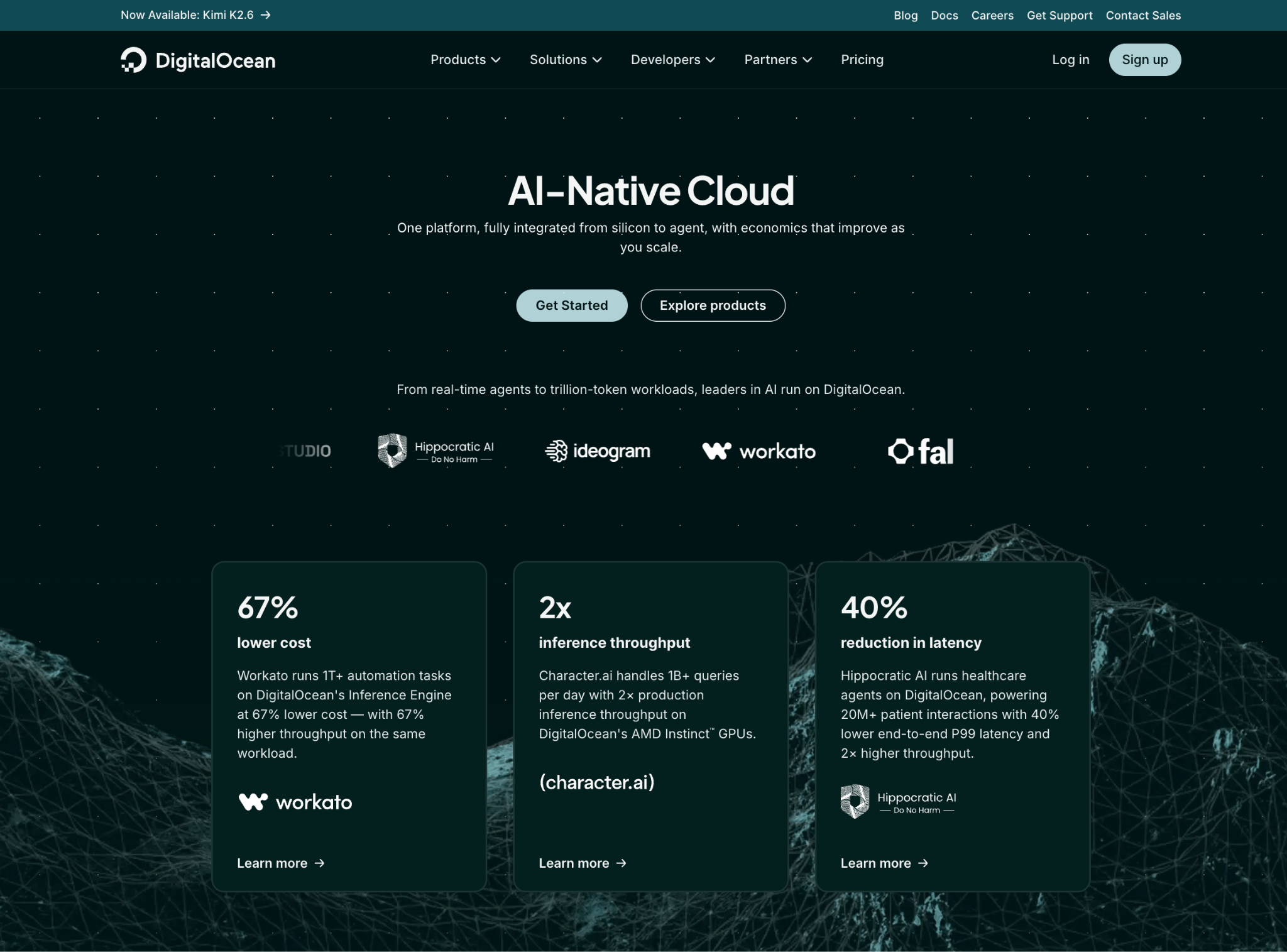
DigitalOcean’s AI-Native Cloud is designed for AI-native startups and digital-native enterprises that need to run production inference workloads at scale. It integrates technologies from NVIDIA, AMD, and MongoDB to power data transmissions and effectively store it across your infrastructure. You can use the DigitalOcean AI Platform to build and scale serverless inference using a centralized interface with capabilities for agent creation, model training, and fine-tuning. 1-Click Models are also available to quickly generate endpoints from providers such as OpenAI, Anthropic, Mistral, and Meta. For compute power, you can run inference on GPU Droplets® and Bare Metal GPUs.
DigitalOcean key features:
-
Serverless inference endpoints provide managed model serving with automatic scaling and integrated request handling for production AI workloads.
-
Integrated low-latency networking and GPU-backed infrastructure optimize real-time inference performance for applications such as chat, search, and agent-based systems.
-
Managed model deployment workflows handle packaging, versioning, and rollout of models without requiring manual infrastructure setup or orchestration.
-
AI Platform: Starting at $0.15/1 Million tokens. Developers can create custom AI agents and integrate LLMs into their workflows without managing infrastructure.
-
GPU Droplets - Starting at $1.88/GPU/Hour (based on multi-month contractual commitment). Run training and inference on AI/ML models, and process large data sets and complex neural networks.
-
Bare Metal - Custom pricing. Access single-tenant, dedicated GPU servers in New York and Amsterdam data centers. Contact DigitalOcean to reserve capacity.
Work with DigitalOcean to help optimize your inference workloads for performance. Read how we helped Character.ai achieve a 2x inference performance increase with AMD hardware in this technical case study.
2. AWS SageMaker Inference featuring multiple inference types and AWS integration
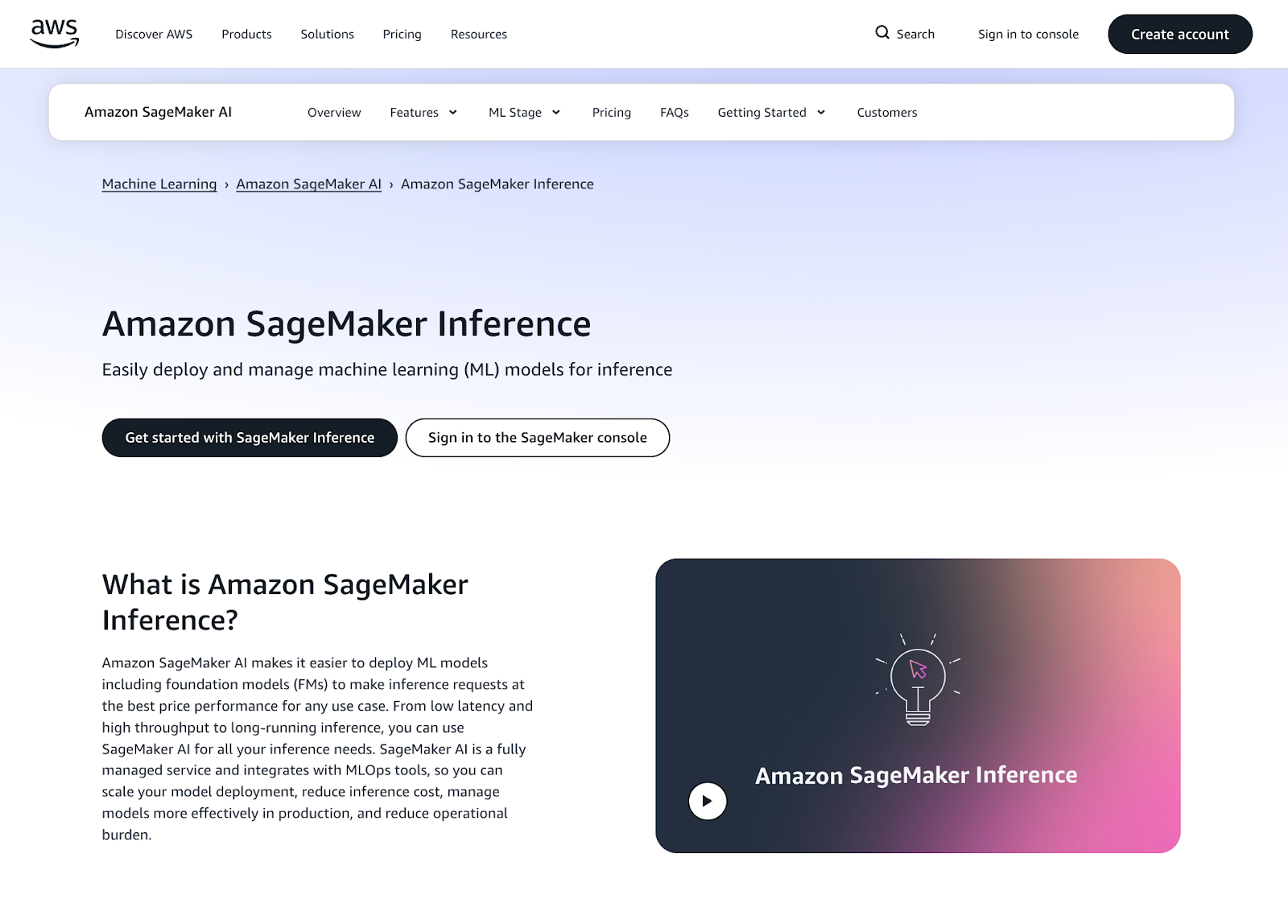
AWS SageMaker Inference is a fully managed service that integrates with MLOps tools so you can integrate foundational models for inference into your applications. As part of the broader AWS ecosystem, you can use it with specialized EC2 instances and connect it to applications within the overall AWS portfolio. It provides options for real-time, serverless, asynchronous, and offline (batch transform) inference. SageMaker Inference models support a variety of inference requirements, including high- and low-latency and high-throughput use cases. You can also access specialized deep learning container (DLC) libraries and tooling for large model inference to increase foundational model performance. Its features reduce manual MLOp requirements by decreasing the operational overhead associated with model deployment, version management, and patch updates. The top inference options are single-model endpoints, multiple models on a single endpoint, or serial inference pipelines.
AWS SageMaker Inference key features:
-
Support for TensorFlow Serving, TorchServer, NVIDIA Triton, and AWS multi-model server.
-
Suitable for multilingual text processing, text-image processing, multi-modal understanding, natural language processing, and computer use cases with over more than 100 infrastructure instance types.
-
Capabilities for inference optimization, shadow testing, autoscaling, and intelligent routing.
AWS SageMaker Inference pricing:
-
Free Tier - $0/6 months. Includes 125 hours of m4.xlarge or m5.xlarge instances for real-time inference, as well as 150,000 seconds of on-demand inference duration for serverless inference.
-
Real-Time Inference - Starting at $0.056/hour. Includes ml.t2.medium instance with 2 vCPUs and 4 GB of RAM.
-
Asynchronous Inference - Starting at $0.056/hour. Includes ml.t2.medium instance with 2 vCPUs and 4 GB of RAM.
-
Serverless Inference - Starting at $0.0000200/second with 1GB of RAM. Data processing is $0.016/GB for each way (in and out).
-
Batch Transform - Starting at $0.121/hour. Includes ml.m7i.large instance with 2 vCPUs and 8 GB of RAM.
3. Akamai Inference Cloud with an edge inference solution
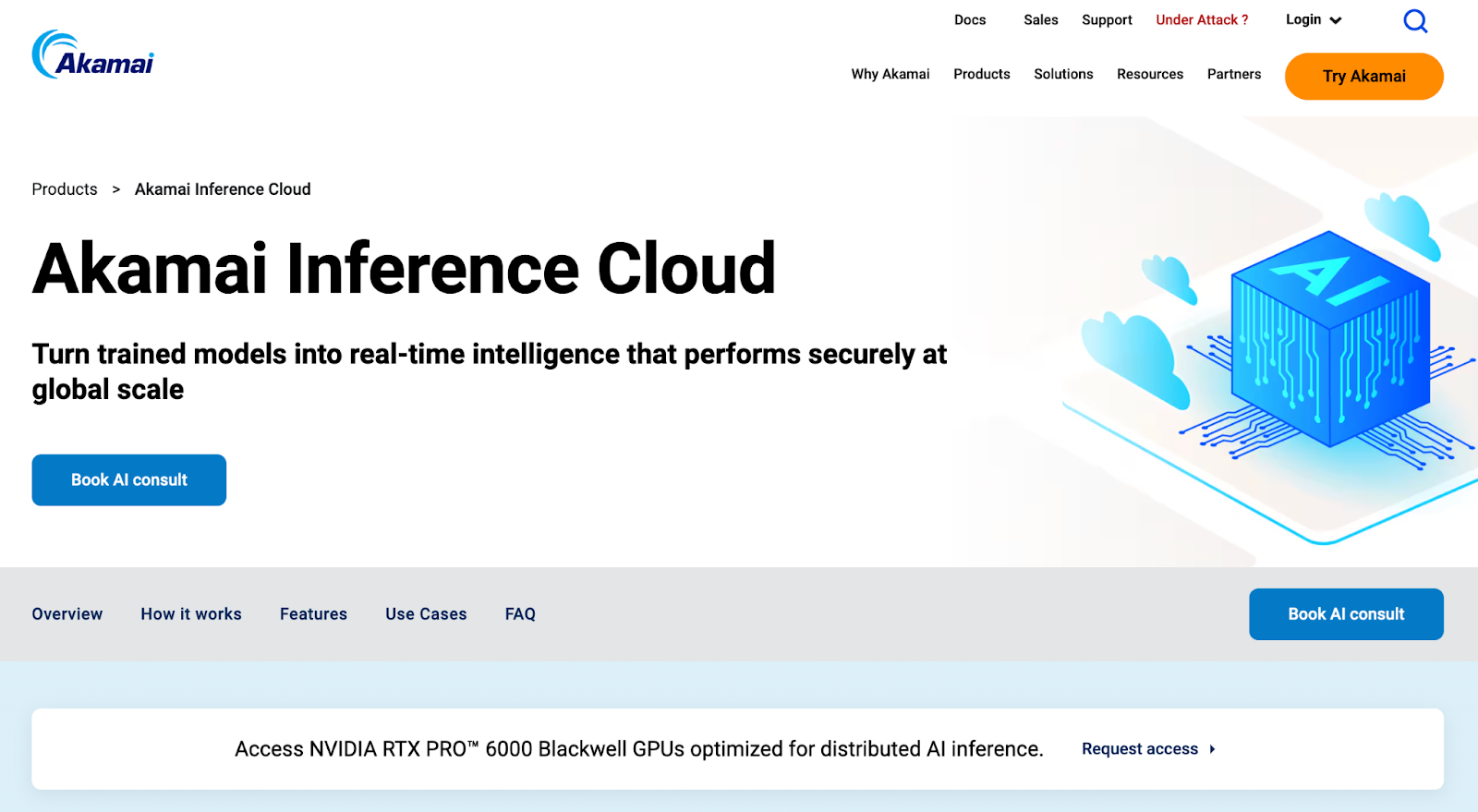
Akamai’s Inference Cloud is a full-stack, globally distributed inference offering that supports edge network use cases and enables developers to run workloads closer to the original data source. It’s also just one part of the overall Akamai Cloud portfolio, giving connectivity to the company’s storage, content delivery, and security products. The ability to route network traffic to the most suitable GPU region can help reduce inference latency and provide a consistent end-user experience. Agentic AI application deployment and monitoring are available through the LKE Managed Kubernetes Engine. Integrations include preconfigured Kubernetes software that orchestrates vLLM, KServe, NVIDIA Dynamo, NeMo, and NIMs. For security, Akamai includes network-level defense, adaptive threat protection, and API security at the edge.
Akamai Inference Cloud key features:
-
Combine edge inference with Akamai’s CDN and caching layers to support hybrid delivery patterns, where responses can be served from cache, computed at the edge, or routed to centralized environments based on request context.
-
Run GPU-accelerated inference workloads on distributed edge infrastructure integrated with NVIDIA hardware and software stacks, supporting deployment of large models outside centralized cloud regions.
-
Support real-time inference pipelines that combine edge compute, caching layers, and origin fallback logic, allowing responses to be served from cache, recomputed at the edge, or routed back to centralized infrastructure when needed.
Akamai Inference Cloud pricing:
-
NVIDIA RTX PRO 6000 Blackwell Server - $2.50/hour for 1 GPU with 176 GB of RAM, 16 vCPUs, and 1024 GB of storage.
-
NVIDIA RTX 4000 Ada Generation - $0.52/hour for 1 small GPU with 16 GB of RAM, 4 CPUs, and 500 GB of storage.
-
NVIDIA RTX 6000 Quadro - $1.50/hour for a dedicated 32 GB and 1 RTX 6000 Quadro GPU, 32 GB of RAM, 8 CPUs, and 640 GB of storage.
API and code-based inference platforms
These options are specifically designed to run large language models and support high-throughput optimization and token generation, and they primarily do so through an API, a CLI, or created endpoints.
4. Baseten with model training features and hybrid deployment options
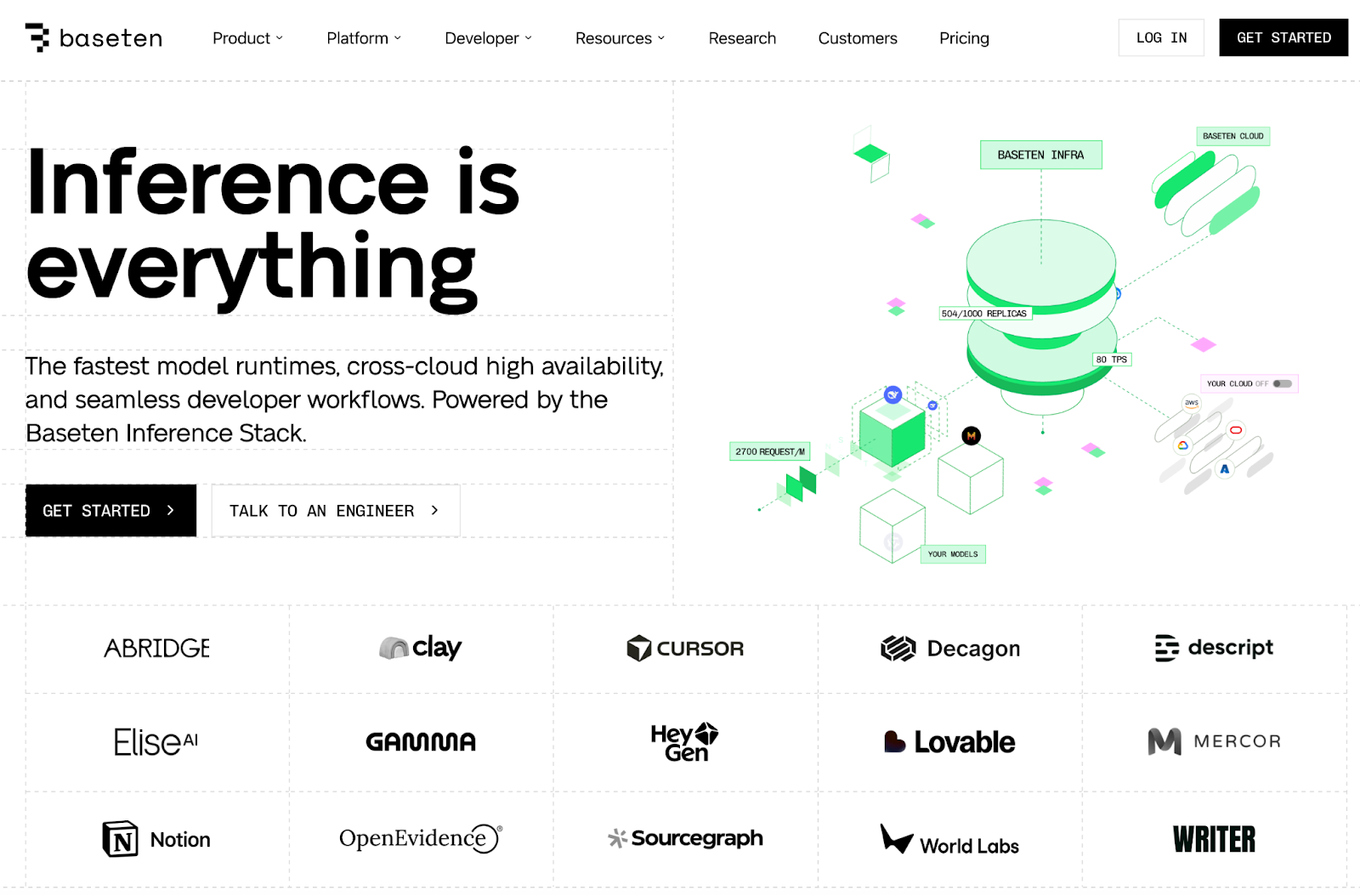
Baseten provides both infrastructure and a platform for running open-source applications and AI models on its hosted cloud, in hybrid deployments, or on your own server. You can launch automatic runtime builds for TensorRT, SGLang, vLLM, TGI, TEI, and configure them from a single file to support your preferred performance. Models can be deployed in a few clicks through Baseten’s model library, which offers the latest options for LLMs, transcription, text-to-speech, image generation, embedding, image processing, and streaming use cases. The company also has a product focused on model training, where you can use your own custom training scripts or provided ones with Baseten infrastructure.
Baseten key features:
-
Multi-cloud capacity management is a control layer that can provision and scale thousands of GPUs across the company’s inference stack (Baseten Cloud, hybrid, and self-hosted deployments).
-
Kernel fusion to combine multiple operations (matrix multiplication, bias addition, and activation functions) into a single GPU kernel to reduce overall overhead and resource usage.
-
Having runtimes use spec-adherence for structured output by biasing logits according to a state-machine-generated prior before decoding, ensuring no reduction in intertoken latency.
-
Basic - $0/month. Includes dedicated deployments, Model APIs, training, fast cold starts, SOC 2 Type II, and HIPAA, along with email and in-app chat support.
-
Pro - Custom pricing. Includes everything in Basic as well as priority access to high-demand GPUs, dedicated compute, higher Model API rate limits, hands-on engineering expertise, and dedicated support on Slack and Zoom.
-
Enterprise - Custom pricing. Everything in Pro plus custom SLAs, self-host deployments, on-demand flex compute, full control over data residency, custom global regions, and role-based access control with teams.
5. Fireworks AI Inference Cloud featuring open source inference support
The Fireworks AI Inference Cloud is designed to optimize and run open-source AI on a global scale. You can create agentic systems, enterprise RAG, text, vision, conversational AI, search, and coding assistant applications with any of its 400 models (including Meta, Qwen, and DeepSeek). Post-deployment, you can fine-tune models with Multi-LoRA and reinforcement fine-tuning (RFT). Its Python SDK is compatible with OpenAI but, on its own, offers Fireworks-exclusive features and platform automation capabilities.
Fireworks AI key features:
-
Integration with PyTorch, Hugging Face Transformers, custom model artifacts, LangChain orchestration frameworks, vector databases, and OpenAI-compatible APIs.
-
High-performance inference engine optimized for GPU utilization, dynamic batching, and low-latency request processing across large-scale model deployments.
-
Multi-model routing and scaling capabilities that distribute inference requests across optimized deployments to maintain throughput under variable workloads.
-
Less than 4B parameters - $0.10/1 Million tokens
-
4B–16B parameters - $0.20/1 Million tokens
-
More than 16B parameters - $0.90/1 Million tokens
-
MoE 0B–56B parameters - $0.50/1 Million tokens
-
MoE 56.1B–176B parameters - $1.20/1 Million tokens
Pricing is for serverless inference text and speech models.
6. Together AI with full-stack, AI native inference workload support
The Together AI platform is a full-stack offering that supports inference, model shaping, and pre-training. You can use it to run serverless inference, batch inference, dedicated model inference, and dedicated container inference. If you don’t want to bring your own models, its library has options from Google, OpenAI, ByteDance, Moonshot AI, Mistral, Rime, Alibaba, and more. Dedicated inference deployments let you deploy models on your own custom endpoints (with custom hardware and scaling configurations) for more predictable performance and greater customization, supporting your model in running effectively for its intended use case. Model shaping is available with fine-tuning capabilities via LoRA or Together AI’s full-fine tuning feature, so you can reduce hallucinations and create more predictable model behavior.
Together AI key features:
-
Integrated data pipelines and tooling for dataset ingestion, preprocessing, and evaluation workflows.
-
Batch inference capabilities for processing large-scale workloads asynchronously across distributed GPU infrastructure.
-
Compatibility with open-source model ecosystems, including support for frameworks like PyTorch and integration with popular model repositories.
On-demand GPU clusters
-
NVIDIA HGX H100 - $3.49/hour
-
NVIDIA HGX H200 - $4.19/hour
-
NVIDIA HGX B200 - $7.49/hour
Serverless Inference models:
-
Multilingual e5 large instruct - $0.02/1 Million tokens
-
Mxbai Rerank Large V2 - $0.10/1 Million tokens
-
VirtueGuard Text Lite - $0.20/1 Million tokens
-
Llama Guard 4 12B - $0.20/1 Million tokens
7. Modal featuring low-latency deployments and Python SDK
Modal provides code-first inference offering that lets you run low-latency inference via open weights or custom models. Its core platform includes functionality for inference workflows, model training, development sandboxes, batch inference, and notebook deployment. You define your code with Python in the Modal SDK and have the platform map machine learning dependencies and GPU requirements. For training, you can define the training function within the Modal SDK and port in training data from Modal distributed Volumes, cloud buckets, or your local file system. Modal Notebooks are also available for real-time code and collaboration.
Modal key features:
-
Sandboxes are secure runtime containers for executing arbitrary or untrusted user or agent code.
-
Web endpoints can expose functions over HTTP, including FastAPI-based endpoints, full ASGI/WSGI apps, and WebSocket-capable services.
-
Volumes is a distributed file system for write-once, read-many workloads such as storing and distributing model weights for inference.
-
Starter - $0/month. Includes $30/month of free credits (subject to eligibility requirements), 3 workspace seats, 100 containers, and 10 GPU concurrency, limited cron jobs and web endpoints, real-time metrics and logs, as well as region selection.
-
Team - $250/month. $100/month of free credits, unlimited seats, 1000 containers, and 50 GPU concurrency, unlimited crons and web endpoints, custom domains, static IP proxy, and deployment rollbacks.
-
Enterprise - Custom. Volume-based discounts, unlimited seats, higher GPU concurrency, support via private Slack channels, audit logs, Okta SSO, and HIPAA.
Modal pricing does not include compute expense, which is extra on top of your plan bill. GPUs are available by per-second and per-hour pricing.
Machine learning teams are increasingly looking beyond Modal as workloads grow more complex and diverse. The Modal alternatives article explores a range of platforms—from serverless GPU providers to full MLOps stacks—highlighting how each option balances ease of use, autoscaling, cost efficiency, and control.
Open-source forward inference options
If you’re looking for something primarily focused on open-source code but that also offers expanded support, there are inference platforms designed for these workflows. This can streamline the transition from using self-hosted AI inference to a more managed platform as your requirements grow over time.
8. BentoML featuring a unified inference platform and open-source model integration
BentoML is a unified inference platform designed for deploying and running AI systems at scale. Developers can use its Open Model Catalog to deploy with almost any model or to any cloud that meets their inference requirements. Open source models are available from Llama 4, DeepSeek, Flux, Qwen, and GPT-OSS, or you can upload your own custom models for deployment. Its Inference Platform comes with capabilities for deployment automation, CI/CD pipelines, observability, resource and quota tracking, and granular access control. For cloud options, you can either bring your own cloud or use Bento Cloud for access to NVIDIA and AMD GPU computing power.
BentoML key features:
-
Bento packages bundle models, dependencies, and inference code into versioned, portable artifacts for deployment across environments.
-
Support for multi-framework model serving, including PyTorch, TensorFlow, and scikit-learn, with a unified API for building and deploying inference services.
-
Adaptive batching and runner abstractions that manage concurrent inference workloads and optimize resource use during model serving.
-
Starter - Pay as you go. Dedicated deployments, pay only for the compute you use, fast cold start, autoscaling, SOC 2 Type II compliance, monitoring and logging dashboard, and community Slack support.
-
Committed Use Discount - Custom pricing. Priority access to H100 and H200 GPUs, unlimited seats and deployments, dedicated compute pool, cold-start guarantee, region selection, and dedicated Slack channel.
-
Enterprise - Custom pricing. Full control in your VPC or on-premise deployment, tailored performance research, custom SLAs, full control over data and network policies, multi-cloud and hybrid compute orchestration, audit logs, SSO, compliance evidence kit, and dedicated engineering support.
Inference engines and frameworks
These engines are ideal if you want to run inference but need a lightweight framework (as opposed to a fully built-out platform) that makes it easy to maintain while still giving you almost full control over your models and configurations.
9. vLLM with open-source inference engine for self-managed deployments
vLLM is a high-throughput, memory-optimized inference engine for large language models. Originally developed at UC Berkeley, it’s a community project with over 2.4K contributors and 73.7K Stars on GitHub. It manages key-value memory using the PagedAttention algorithm to optimize inference speed and serving. It is suitable for model execution with CUDA/HIP graph, optimized CUDA kernels, and speculative decoding. You can also use it for integration with HuggingFace models, Tensor, pipeline, data, and expert parallelism support distributed inference use cases. Quantization is available through GPTQ, AWQ, INT4, INT8, and FP8 models. It’s a suitable, open-source option that you can use to get started with self-hosted AI inference, but you might find that, over time, there are considerations regarding community maintenance, lack of a product roadmap, and scaling limits.
vLLM key features:
-
Compatible with NVIDIA GPUs, AMD GPUs, Intel Gaudi accelerator, IBM Spyre accelerator, and Google TPUs.
-
Runs models from DeepSeek, Google, Meta, Mistral AI, NVIDIA, Qwen, StepFun, and Z-AI.
-
Continuous batching features that process incoming requests dynamically to improve GPU utilization and throughput for LLM inference workloads.
vLLM pricing:
vLLM is open source and free to use (subject to license terms). It is run by community donations along with corporate and academic sponsors.
10. NVIDIA Dynamo with distributed inference at scale and GPU optimization
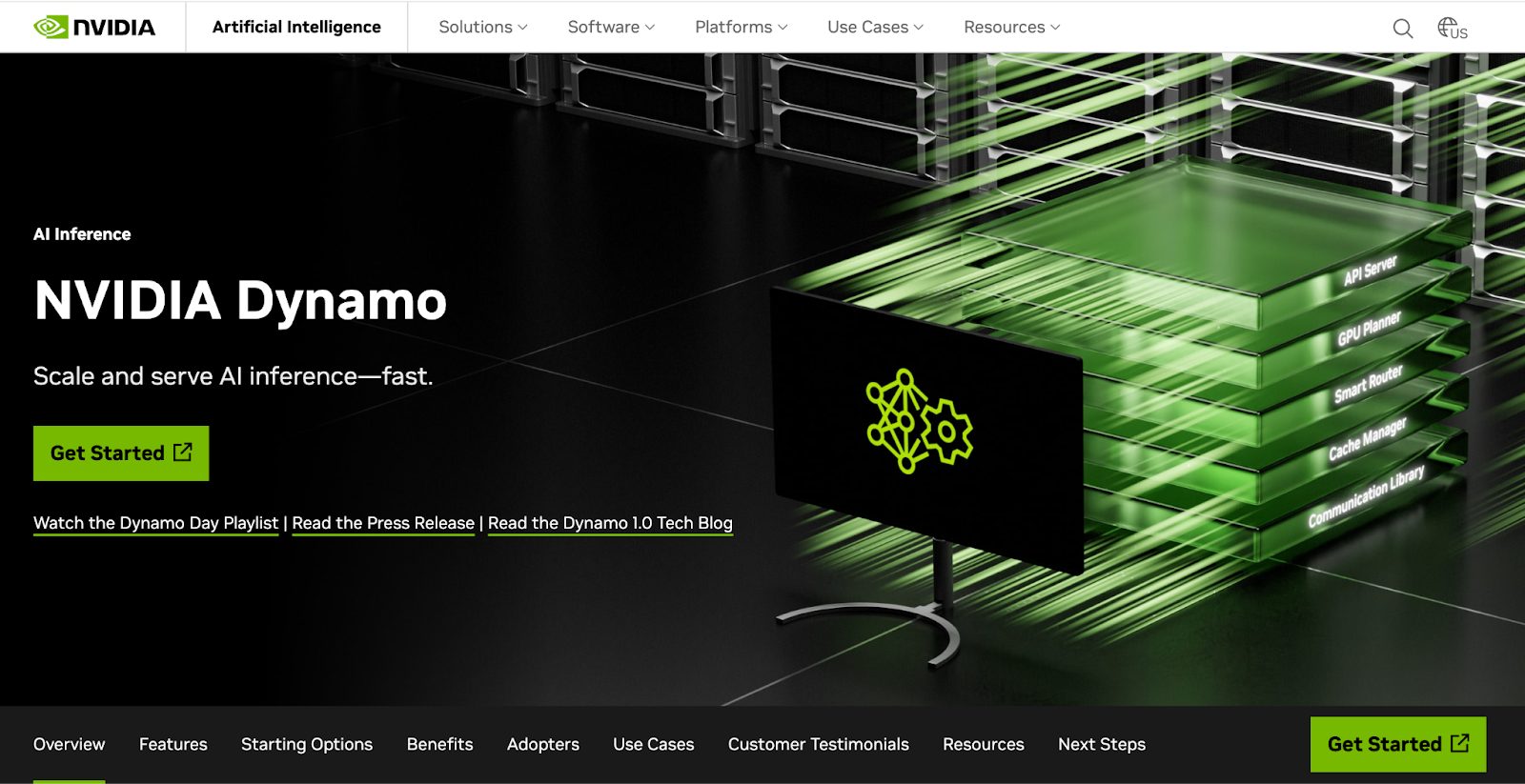
NVIDIA Dynamo is an open-source distributed inference-serving framework that enables developers to deploy models across multi-mode infrastructure configurations. It is compatible with open-source inference engines such as SGLang and NVIDIA TensorRT-LLM to streamline distributed GPU computing and model deployment across the data center. Among its capabilities are a GPU Planner to monitor GPU capacity and dynamically distribute inference; a Low-Latency Communication Library (NIXL) that streamlines data movement across hardware; and KV Caching for moving KV cache data off the GPU into storage. You can also use its LLM-Aware Router feature to direct inference traffic so loads are balanced across GPU fleets. All of these features provide ways to actively optimize NVIDIA GPU performance for your inference workloads, helping workloads run smoothly regardless of your infrastructure configuration.
NVIDIA Dynamo key features:
-
Native support for NVIDIA GPU inference and orchestration integrates with Kubernetes and cluster managers to coordinate multi-node, multi-GPU deployments with high-throughput scheduling.
-
Dynamic request routing distributes inference workloads across available GPU resources based on real-time load and latency conditions.
-
High-throughput token streaming pipeline supports low-latency, incremental output delivery for real-time LLM applications such as chat and agent workflows.
NVIDIA Dynamo pricing:
- NVIDIA Dynamo is open source and free to use (subject to license restrictions). Costs come with using associate compute through NVIDIA infrastructure partners.
AI Inference Platforms FAQ
What is AI inference, and why does it matter for production? AI inference is the process of using a trained machine learning model to generate predictions or decisions based on new, unseen data. In production environments, efficient inference is critical because it directly impacts the end-user experience through response latency and system reliability. DigitalOcean provides high-performance infrastructure and software—such as GPU Droplets, Bare Metal Servers, and the DigitalOcean AI Platform—to help ensure your production inference workloads remain fast and scalable.
Are there open-source AI inference platforms? Yes, several open-source frameworks and engines, such as vLLM and BentoML Open Source, allow developers to maintain full control over their inference infrastructure. These tools can be deployed on DigitalOcean’s managed Kubernetes service or GPU Droplets to combine open-source flexibility with scalable cloud power. Some developers choose these options to avoid vendor lock-in while building production-grade AI applications.
What providers offer GPU support for AI workloads? DigitalOcean offers extensive GPU support for AI workloads through its DigitalOcean AI-Native Cloud, featuring NVIDIA H100 and H200 GPUs as well as AMD Instinct MI300X options. These resources are available as on-demand virtual machines, managed Kubernetes nodes, or dedicated bare metal servers to suit different scale requirements.
Who offers scalable infrastructure for AI applications? Scalable AI infrastructure is primarily provided by major cloud platforms, which offer expansive global networks and specialized hardware like GPUs and TPUs. API-focused providers such as Baseten, Together AI, and Modal also offer access to scalable infrastructure. DigitalOcean supports AI applications and inference at scale with options such as GPU Droplets and the DigitalOcean AI Platform.
Deploy on DigitalOcean’s AI-Native Cloud
DigitalOcean has spent over a decade building cloud infrastructure for developers, from virtual machines and managed Kubernetes to object storage, managed databases, and app hosting. DigitalOcean’s AI-Native Cloud extends that same simplicity to AI workloads, giving teams the tools to train, run inference, and deploy agents at scale without the operational overhead. We offer multiple paths to get your AI workloads into production:
DigitalOcean AI Platform—build and deploy AI agents with no infrastructure to manage
-
Serverless inference with access to models from OpenAI, Anthropic, and Meta through a single API key
-
Built-in knowledge bases, evaluations, and traceability tools
-
Version, test, and monitor agents across the full development lifecycle
-
Usage-based pricing with streamlined billing and no hidden costs
GPU Droplets®—on-demand GPU virtual machines starting at $0.76/GPU/hour
-
NVIDIA HGX™ H100, H200, RTX 6000 Ada Generation, RTX 4000 Ada Generation, L40S as well as AMD Instinct™ MI300X
-
Zero to GPU in under a minute with pre-installed deep learning frameworks
-
Up to 75% savings vs. hyperscalers for on-demand instances
-
Per-second billing with managed Kubernetes support
Bare Metal GPUs—dedicated, single-tenant GPU servers for large-scale training and high-performance inference
-
NVIDIA HGX H100, H200, and AMD Instinct MI300X with 8 GPUs per server
-
Root-level hardware control with no noisy neighbors
-
Up to 400 Gbps private VPC bandwidth and 3.2 Tbps GPU interconnect
-
Available in New York and Amsterdam with proactive, dedicated engineering support
About the author

Jess Lulka is a Content Marketing Manager at DigitalOcean. She has over 10 years of B2B technical content experience and has written about observability, data centers, IoT, server virtualization, and design engineering. Before DigitalOcean, she worked at Chronosphere, Informa TechTarget, and Digital Engineering. She is based in Seattle and enjoys pub trivia, travel, and reading.
Start building today
From GPU-powered inference and Kubernetes to managed databases and storage, get everything you need to build, scale, and deploy intelligent applications.